
St. Joseph County Court Records After a Jail Arrest
In St. Joseph County, Michigan, the court record after a jail arrest usually starts after police complete the first custody step and send the case toward charging review. The county prosecutor's criminal-case progression material explains the sequence locally: an investigation identifies a suspect, police gather reports and evidence, and an officer submits a warrant request to the St. Joseph County Prosecuting Attorney's Office. The prosecutor reviews police reports, witness statements, and prior criminal or traffic history before deciding whether to authorize charges.
When charges are authorized, the complaint is filed in District Court and signed under oath by an officer from the investigating department. A magistrate reviews the warrant and probable-cause affidavit. That is the key transition from arrest information to court records. The jail may have booking charges or hold information, but the court case reflects what the prosecutor actually filed, what the magistrate accepted, and how the case later changed. For the custody side, use jail inmate records. For booking photographs, use jail roster mugshots.
The official prosecutor case-progression page is the best local source for understanding how arrest, warrant request, complaint, magistrate review, and bond fit together.
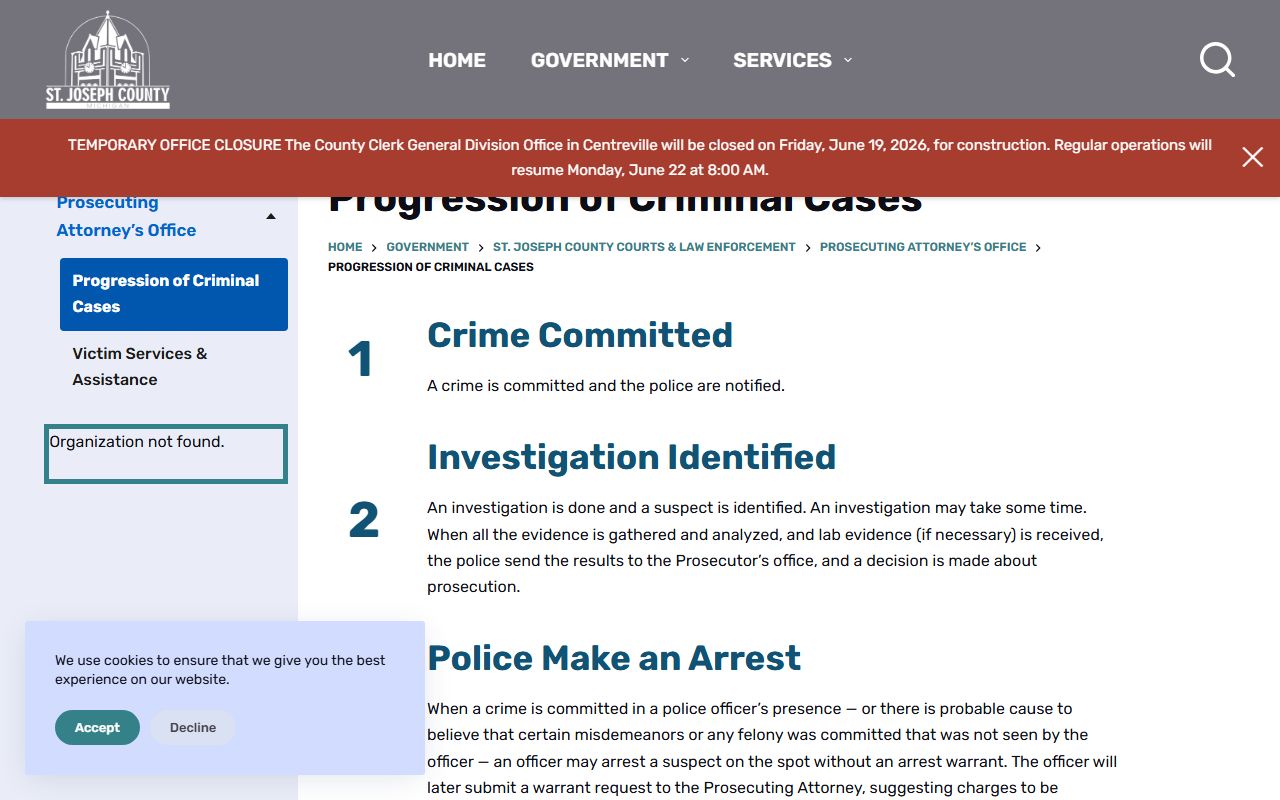
That sequence matters because the wording used at booking may not match the final court-record wording after prosecutor review.
How to Find Court Records After an Arrest in St. Joseph County
Start by deciding whether the matter is still only a booking, an open District Court case, a felony case moving to Circuit Court, or a sentenced state-corrections case. The 3B District Court handles St. Joseph County misdemeanors, major traffic matters, felony-charge first stages, and other criminal matters listed by the court. The 45th Circuit Court handles felony trial-court matters and links users to MiCOURT for participating court records.
- Search the local 3B District Court case index by last name, first name, birth year, or case number.
- Use the 3B District Court calendar for hearing dates, scheduled events, action entries, judges, attorneys, and case numbers.
- Check the 45th Circuit Court page and MiCOURT Case Search when a felony is bound over or a circuit record is needed.
- If online access is limited, contact the proper clerk or use the county records process rather than assuming no case exists.
The 3B index is a local table, not a jail roster. It is useful after a complaint has been filed or a court case has otherwise appeared. The public fields captured in research include detail, last name, first name, birth year, case number, status, attorney, and page size.
| 3B District Court Field | How It Helps | Notes |
|---|---|---|
| DETAIL | Opens or identifies a record detail entry. | Use after locating the likely case row. |
| LAST NAME | Filters by defendant surname. | Pair with first name and birth year for common names. |
| FIRST NAME | Filters by given name. | Spelling variations can affect results. |
| Birth Year | Separates people with similar names. | Useful when a full date of birth is not public. |
| CASE # | Directly searches a known local case number. | Best when paperwork or bond documents list the case. |
| STATUS | Shows open or closed status in the case table. | Not the same as a dedicated warrant field. |
| ATTORNEY | Shows attorney name when listed. | May help confirm the correct case. |
The 3B District Court case index displays the searchable local grid used for post-arrest court records.
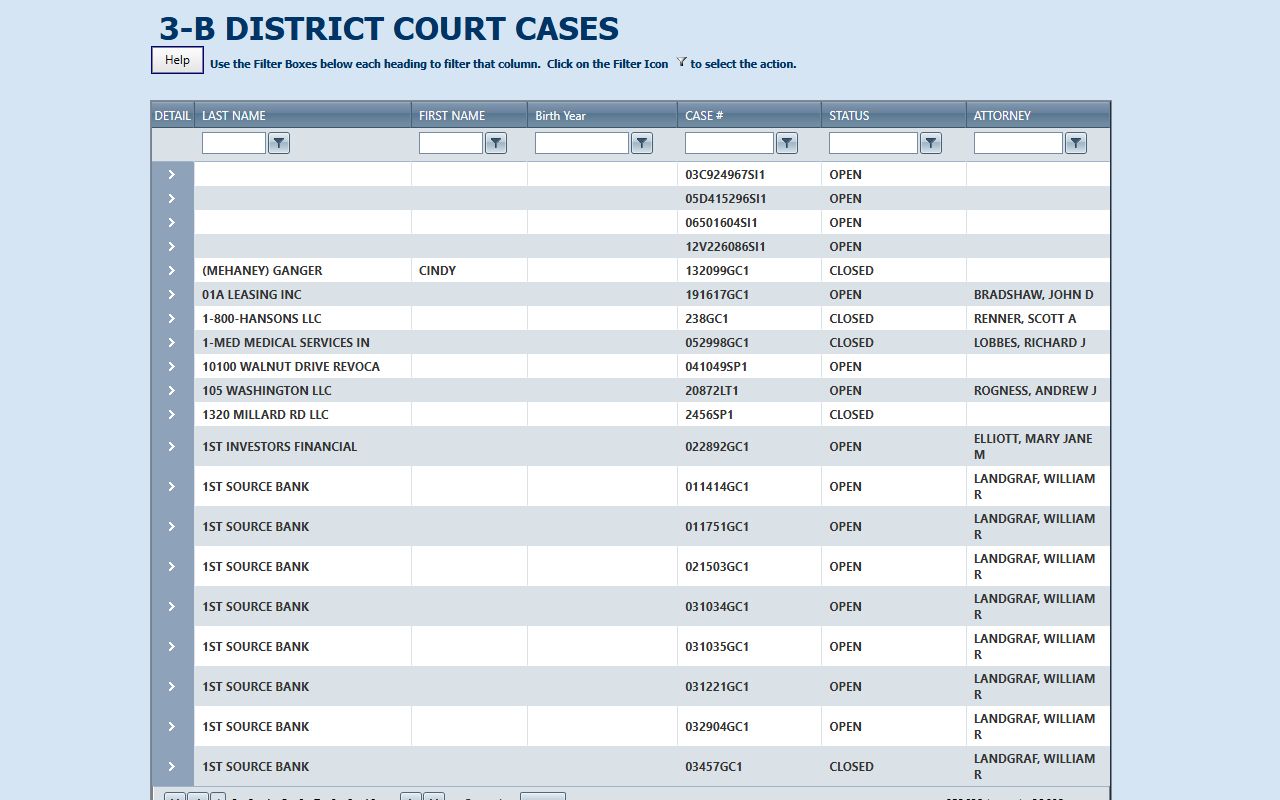
Use the court index together with custody confirmation because a new arrest may be in jail before the court case is visible online.
How Court Records Start After Arrest: Complaint, Information, and Indictment
The St. Joseph County prosecutor page specifically identifies the complaint as the charging document used when the prosecutor authorizes a charge. The complaint is filed in District Court and signed under oath, then a magistrate reviews the warrant and affidavit of probable cause. Michigan cases can also involve an information after felony proceedings move forward. Indictments are less common in routine local District Court charging, but the term appears in criminal procedure and is best understood as a grand-jury charging document rather than a booking record.
| Document | What It Does | St. Joseph County Context |
|---|---|---|
| Complaint | Starts the prosecutor-authorized court charge. | The prosecutor page says authorized charges are issued on a complaint filed in District Court. |
| Information | States felony charges for later trial-court proceedings after preliminary stages. | Relevant when felony matters move beyond the District Court stage toward Circuit Court. |
| Indictment | Grand-jury charging document. | Not the usual public path described by the county prosecutor's local progression page. |
Charge Status in Court Records After an Arrest
Charge status is where many court-record searches become confusing. A person can be booked on one description, charged by complaint under another description, and later face an amended or reduced count. A pending charge is not a conviction. A dismissed charge is not the same as a plea. A bound-over felony means the case is moving from District Court toward Circuit Court, not that the person has already been convicted.
| Status | What It Means | Why It Matters |
|---|---|---|
| Pending | The charge has not reached final disposition. | Hearing dates, bond, and motions may still change the record. |
| Amended | The filed charge was changed by prosecutor or court action. | Do not rely only on the booking description. |
| Reduced | A less serious charge replaced or resolved the original allegation. | Often appears with plea negotiations or court rulings. |
| Dismissed | The charge was removed by prosecutor or court action. | Dismissal is not a conviction, but the case record may still exist unless restricted. |
| Bound over | A felony matter moved from District Court toward Circuit Court. | Search both local District Court history and Circuit/MiCOURT records. |
| Disposition | The final case outcome. | Read each count separately when several charges exist. |
District Court, Circuit Court, MiCOURT, and Clean Slate Records
For St. Joseph County court records after a jail arrest, 3B District Court is usually the first place to search for local misdemeanor cases and felony preliminary activity. Felony cases can later appear through 45th Circuit Court and MiCOURT. The Circuit Court page includes a practical limitation: effective April 11, 2023, online criminal viewing reflects cases from 2017 to present, and case accuracy before 2017 must be verified manually. The page also noted that the public viewing terminal was unavailable for criminal cases when inspected.
That Clean Slate caveat should shape older searches. A missing online result may mean the case predates the current online range, is restricted, has been set aside, is nonpublic, or must be verified manually. It should not automatically be treated as proof that no arrest, complaint, warrant, or court record ever existed.
Bond and Release After a Jail Arrest
Bond is part of the court pathway, not just a payment step at the jail. The prosecutor's local case-progression material says that after a warrant is issued, a magistrate sets bond based on the seriousness of the crime, flight risk, and danger to the victim or public. The magistrate may also impose no-contact conditions. Victim Services material says victims can ask that bail be revoked if threatened by the defendant.
| Bond Outcome | How It Works | Important Caveat |
|---|---|---|
| Personal recognizance | Release based on a promise to appear and comply with conditions. | Violating conditions can trigger a warrant or revocation. |
| Cash bond | Money is posted directly under court rules. | Confirm the exact amount and case before paying. |
| Surety bond | A bonding agency may post under the court's bond terms. | The sheriff's forms page lists a bonding-agencies document. |
| Conditional release | Release may include no-contact, testing, supervision, or travel limits. | Conditions are part of the court record and can affect later hearings. |
| No-bond or hold | The person cannot be released through ordinary bond at that time. | Other warrants, detainers, probation/parole holds, ICE holds, or court orders can block release. |
Warrants and Bench Warrants After an Arrest
No official St. Joseph County, Michigan active-warrant search page was located in the research. Use the local court and sheriff channels instead of unofficial warrant aggregators or St. Joseph County, Indiana pages. The county prosecutor explains that police submit warrant requests, the prosecutor decides whether to authorize a charge, and a magistrate reviews the warrant and probable-cause affidavit. Warrants can remain active for a year or more and sometimes several years, although many are served within weeks or months.
Bench warrants are different. The 3B District Court page warns that most criminal cases require personal appearance and that failure to appear as required may result in a bench warrant. To research warrant-related court records after an arrest, call the Sheriff's Office at (269) 467-9045 for custody routing, search the 3B case index and court calendar, check 45th Circuit/MiCOURT for felony matters, and use FOIA or clerk channels for written records that are not online and are not exempt.
Charges vs. Convictions in Court Records After Arrest
A court charge is an accusation filed through the court process. A conviction is a final legal outcome after a plea, verdict, or other finding of guilt. Arrest, booking, complaint filing, and bond all can produce records before any conviction exists. Read the disposition for each count rather than treating an arrest or charge as a final result.
| Issue | Charge | Conviction |
|---|---|---|
| Stage | Accusation after prosecutor/court filing. | Final guilt outcome by plea, verdict, or court finding. |
| Legal meaning | Shows what the prosecutor alleged. | Shows the count on which guilt was established. |
| Can change? | Yes. Charges can be amended, reduced, or dismissed. | Can be affected by appeals, set-aside orders, or later court action. |
| Search caution | Not proof of guilt. | Still verify final disposition and any later restrictions. |
Sealed vs. Set-Aside Court Records After Arrest
Michigan often uses "set aside" language for adult conviction relief, while many searchers use "expunged" as the everyday term. MCL 780.621 addresses adult conviction set-aside eligibility, and MCL 780.623 addresses nonpublic records after a set-aside order. These rules do not mean every arrest record disappears from every government system. They do mean public visibility can change, and some records may become nonpublic while still being retained for limited official purposes.
| Issue | Sealed / Nonpublic | Set Aside / Expunged |
|---|---|---|
| Main effect | Hidden from ordinary public access by law, court rule, or record status. | Eligible Michigan convictions can become nonpublic after qualifying relief or Clean Slate action. |
| Government retention | Some official access may remain for courts, law enforcement, or legally authorized users. | MCL 780.623 addresses nonpublic records after a set-aside order. |
| Search effect | Online court indexes may show limited information or no public case display. | Older online results may change, and private background sites may lag behind official status. |
| Not the same as dismissal | A restricted case is a visibility category. | A set-aside order changes public treatment after a qualifying conviction; dismissal means the charge did not become a conviction. |
Public Access Laws for Arrest and Court Records
Michigan FOIA, MCL 15.231 through 15.235, gives access to nonexempt public records of public bodies and sets response duties after requests. St. Joseph County directs county public-records requests through its JustFOIA public portal and also lists a Sheriff's Department FOIA request document through the sheriff forms page. Court records can also be governed by court rules, clerk access practices, Clean Slate restrictions, juvenile confidentiality, sealed-record rules, and set-aside law.
Access note: Immediate custody questions should go to the Sheriff's Office or jail. Filed charge records belong with 3B District Court, 45th Circuit Court, MiCOURT, and clerk channels. Written booking records, jail logs, or booking-photo requests may require county FOIA.
Background Check Limits for Court Records After an Arrest
Casual court lookup is not the same as a lawful employment, tenant, credit, insurance, or licensing background check. Public court records can be incomplete, delayed, restricted, or later changed by dismissal, plea, amendment, appeal, or set-aside order. For any high-stakes use, verify directly with the originating court, sheriff, Michigan State Police criminal-history channels where appropriate, or qualified legal counsel.
Important: Information here may not be used for FCRA-covered decisions such as employment, credit, tenant screening, or insurance eligibility.